From the first mist on the Ganga to the last lamp floating downstream — the world's oldest living city, structured hour by hour.
By Saurabh - TravelBuddiz FounderMay 26, 202618 min read
Varanasi defies the logic of conventional itineraries. It is not a city of landmarks you tick off a list; it is a city of experiences that accumulate inside you like sediment — layer upon ancient layer. The 3,000-year-old banks of the Ganga hold more human ceremony, more raw spiritual electricity, and more simultaneous beauty and confrontation than anywhere else on earth.
Two days here, structured intelligently, can feel like a week anywhere else. This guide does not try to sanitize Kashi. It does not promise Instagram-perfect mornings or tourist-safe approximations of the real thing. What it offers is a practical, honest, hour-by-hour map through one of the most extraordinary cities human beings have ever built — written with the help of TravelBuddiz community hosts who have lived and guided here for years.
"In Varanasi, the schedule is written by the river, the bells, and the light — not by an app. Follow all three and you will never go wrong."
— Priya Mishra, TravelBuddiz Community Host, Dashashwamedh Ghat
At a Glance
Your 2-Day Varanasi Overview
Duration2 Days
Best SeasonOct – Mar
Daily Budget₹800–1,200
Ghats Covered8+
PaceUnhurried
Base AreaAssi/Godowlia
The city known variously as Varanasi, Kashi, and Banaras is located in eastern Uttar Pradesh, a state with more UNESCO-worthy heritage than most countries. It sits on the crescent bend of the Ganga where the river flows northward — an astronomical anomaly that Hindus believe makes this the most auspicious point on earth for dying and being cremated. Understanding this belief — the sacred geography of Kashi — changes how you see every boat, every lamp, every ritual you witness on these banks.
💡
Getting There in 2026: The Lal Bahadur Shastri Airport (VNS) has direct flights from Delhi (1h 20m), Mumbai (2h 10m), and Bangalore. From Lucknow, the Vande Bharat Express reaches Varanasi in 1h 45m — the fastest and most comfortable option. Book tickets on IRCTC at least a week in advance.
Stay as close to the ghats as your budget allows. The Assi Ghat and Godowlia areas have the best density of guesthouses, homestays, and heritage hotels within walking distance of everything that matters. Pre-dawn alarm clocks are non-negotiable on both mornings — the river at 5:00 AM is a completely different world than the same river at 9:00 AM.
Day 1
Arrival, The Sacred Heart & Ganga Aarti
Your first full day in Varanasi should be structured around three non-negotiable anchors: a pre-dawn ghat walk, the Kashi Vishwanath Temple complex in the morning, and the Ganga Aarti at dusk. Everything else — the alleys, the chai stalls, the silk weavers — flows naturally between these three.
4:45 AM
Wake Up Before the City Does
Set your alarm without negotiation. The city begins its ritual life at 4:30 AM. You want to be on the stone steps of Assi Ghat before the first light touches the river — when the morning mist sits on the water and the chanting from nearby temples carries across the silence like a second current in the Ganga.
Pro Tip: Skip the boat for this first sunrise — a ghat-side seat with your feet on the ancient stone is more viscerally immersive than viewing from water. Save the boat for Day 2 when you have your bearings.
5:00 AM
Assi Ghat — The Southernmost Start
Assi Ghat is where the Assi stream meets the Ganga, and it is the traditional starting point of the pilgrimage walk northward along all 88 ghats. At dawn, fishermen pull nets, priests perform the Surya Puja facing east, and old men practice their morning Suryanamaskars in the mist. Sit on the steps, order a small clay cup of chai from the nearest stall (₹10), and simply watch the ceremony of an ordinary morning.
5:45 AM
The Ghat Walk North — The Most Alive Road in India
Walk northward along the ghat embankment. This is the single most rewarding walk in India: Tulsi Ghat where the Ramcharitmanas was composed; Harishchandra Ghat, the older of Varanasi's two cremation ghats, burning around the clock; Kedar Ghat with its distinctive South Indian temple architecture rising straight from the water; the Dashashwamedh complex beginning to set up for the dawn prayers. Every 50 metres is a different ceremony, a different century.
Manikarnika and Harishchandra Ghats: Witnessing cremations is permitted and meaningful. But photographing or filming the pyres — even discreetly — is a severe violation of the families' privacy and Varanasi's deepest customs. Do not do it. Put your phone away.
8:00 AM
Breakfast — Kachori Sabzi at Kashi Chat Bhandar
Return toward Dashashwamedh and find Kashi Chat Bhandar in the Godowlia market area. The crisp kachori with spiced aloo sabzi and tamarind chutney has been served here since 1960. Pair it with the thick, creamy lhassi served in clay cups from the neighboring stall. Budget ₹80–120. This is Banaras morning food at its most authentic.
10:00 AM
Kashi Vishwanath Temple — The Heart of Hinduism
The Kashi Vishwanath Corridor, inaugurated in 2021 and expanded through 2024–25, has transformed what was once a chaotic, narrow-lane experience into an accessible pilgrimage route linking the temple directly to the Ganga. The temple itself is dedicated to Lord Shiva and is one of the 12 Jyotirlingas — the most sacred of all Shiva shrines. Leave your phone, bag, and leather items at the temple's designated counter and walk through at your own pace.
Entry: Free for Indian nationals with valid ID. Foreign nationals pay ₹300. Photography is strictly prohibited inside the temple complex. The corridor itself (outside) allows photography. Crowds are manageable between 10 AM–12 PM on weekdays.
12:00 PM
The Old City Alleys — Getting Beautifully Lost
The galis (lanes) between Vishwanath Temple and the ghats form one of the oldest continuously inhabited urban networks on earth. Some are wide enough for two people; most are not. Milk vendors on cycles, wedding processions, flower sellers, and schoolchildren navigate these lanes in an improvised choreography that has been running for millennia. Walk without a specific destination for 90 minutes. You will find a silk weaver's loom room, a 500-year-old stepwell, and at least three tea stalls worth remembering.
2:00 PM
Afternoon Rest + Banarasi Silk
The post-noon heat in Varanasi (especially March–October) demands a rest. Return to your guesthouse for a couple of hours. If you want to browse Banarasi silk, the Government Silk Weaving Centre at Chowk is the most reliable source for authentic brocade without commission touts. For contemporary takes on the Banarasi tradition, the lane of Vishwanath Gali has a dozen small workshops where you can watch weavers at the loom.
5:30 PM
Position for Ganga Aarti — Arrive Early
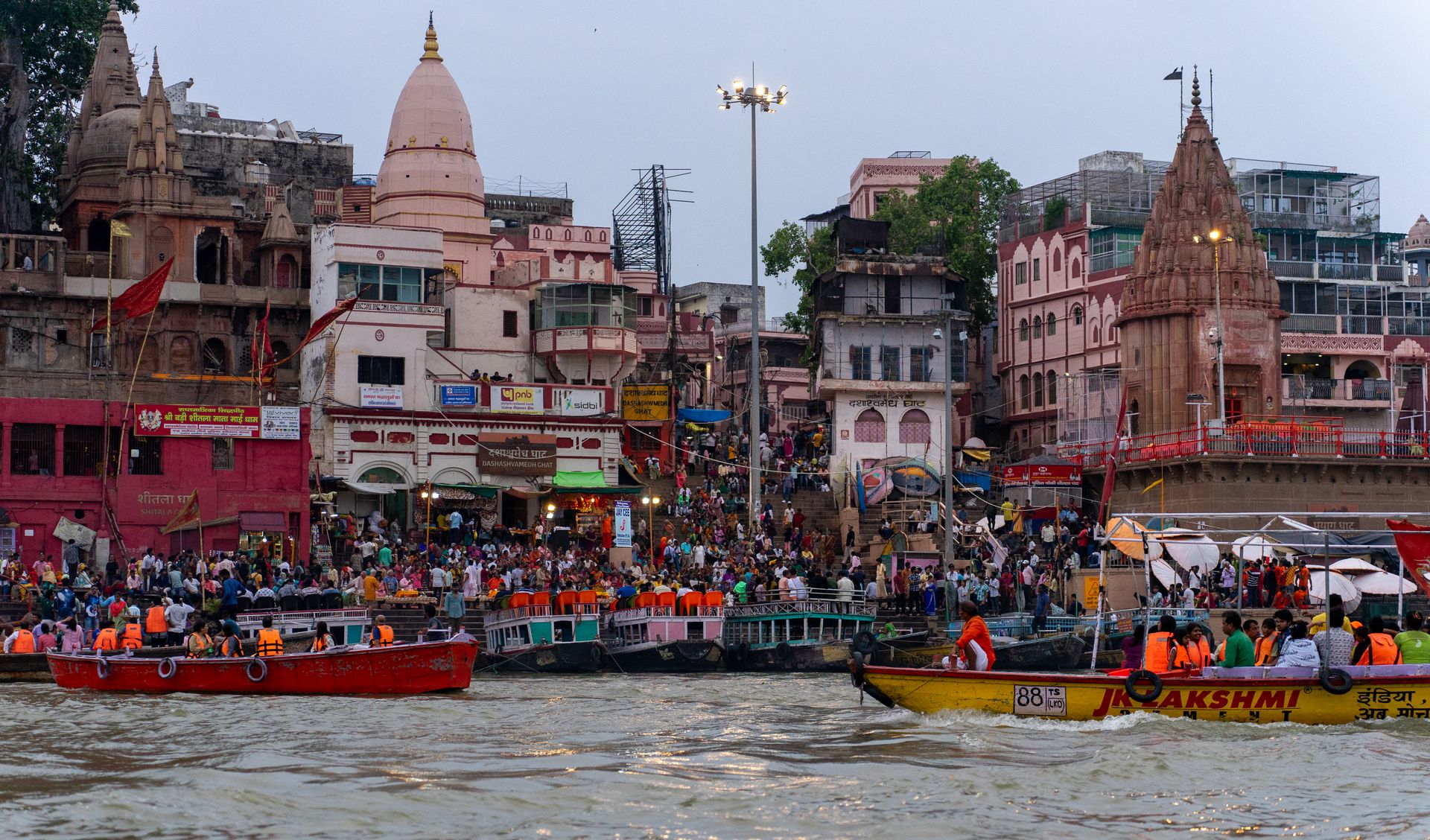
The evening Ganga Aarti at Dashashwamedh Ghat begins at approximately 6:45 PM (varies 10–15 minutes by season). Arrive by 5:30 PM to secure a position on the main stone steps facing the river. The central platforms directly in front of the seven lamp stands fill completely by 6:15 PM. Alternatively, hire a rowboat (₹200–300 per boat for 1-hour view) to watch from the water — a completely different, equally stunning perspective.
Best Positions: Stone steps at the center of Dashashwamedh (free, ground-level, immersive) · Boat on the water (best photographic angle) · First-floor rooftop of the Ganges View Hotel (elevated, clear sightlines, café seating).
6:45 PM
Ganga Aarti — The Ceremony That Defines Varanasi
Seven priests in silk dhotis, each holding an enormous brass lamp with multiple tiers of fire, perform a perfectly synchronized ritual of light, incense, conch-blowing, and sacred chant. The ceremony lasts 45–50 minutes. The sound — thousands of people chanting together, bells ringing from the temple behind, the Ganga flowing silently through it all — creates a sensory experience that is genuinely unlike anything else in India. Do not look at your phone during it.
8:00 PM
Dinner — Thali at Brown Bread Bakery or Aadha-Aadha
Brown Bread Bakery near Assi Ghat is a Varanasi institution — a rooftop café with Ganga-adjacent views, a genuinely excellent tasting thali, and the best banana lassi within 10 km. For a more local experience, Aadha-Aadha in the Bengali Tola area serves proper Banarasi-style dal-baati-chokha. End the evening with a paan from the famous Keshav Pan Bhandar near Godowlia square — the original meetha paan that Banaras claims to have invented.
🪔
Day 2
Boat on the Ganga, Sarnath & The Silent North
Your second day broadens the lens. This morning you see Varanasi from the water — the full sweep of the ghats as they were meant to be seen. The afternoon takes you 10 km north to Sarnath, where the Buddha delivered his first sermon after enlightenment, and where some of the most important Buddhist archaeological sites in the world sit quietly alongside the chaos of Varanasi without a single person rushing.
5:15 AM
The Rowboat Hour — Varanasi From the Water
This is the morning for the boat. Find a boatman at Assi Ghat and negotiate a one-hour row northward toward Manikarnika — ₹200–250 per boat (not per person) is fair for a manual rowboat. From the water, you see the entire vertical city rising like a cathedral: the layered ghats with their specific colors of stone, the temple shikhars piercing the skyline, the smoke from the cremation ghat threading upward, the bathers in their columns of sunlight. No photograph captures this. It has to be witnessed.
Eco Note: Rowboats only for sunrise. Motor boats create noise and diesel fumes that ruin the morning silence for everyone. Rowboats are cheaper, more meditative, and the only appropriate way to see the dawn Ganga.
6:30 AM
Manikarnika Ghat — The Great Cremation Ground
Manikarnika Ghat is the most sacred cremation site in Hinduism — the place where, according to tradition, Shiva whispers the Taraka Mantra into the ear of the dying, ensuring liberation from the cycle of rebirth. The fire here has, according to local tradition, burned continuously for 3,500 years. Approach respectfully, observe from the outer steps in silence, and do not ask the Doms (the hereditary cremation workers) questions about photography.
8:30 AM
Breakfast — Malaiyo and Thandai
Return toward Godowlia for Varanasi's most famous morning dish: Malaiyo (available October–March only) — a cloud-like froth of milk, saffron, and pistachio that dissolves on the tongue. Ask any shopkeeper near Thatheri Bazaar for the nearest Malaiyo wala. In summer months, replace with the thick saffron-almond Thandai served at the stalls near Dashashwamedh.
9:00 AM
Sarnath — Where Buddhism Was Born
Hire an auto-rickshaw or Ola cab from Godowlia to Sarnath (10 km, 25–30 minutes, ₹120–200 by auto). This is one of Buddhism's most sacred sites — the Isipatana deer park where Prince Siddhartha, newly enlightened at Bodh Gaya, delivered his first sermon to five disciples and set the Dhamma Cakka (Wheel of Dharma) in motion. The Dhamekh Stupa (5th century CE, 43.6 metres high) marks the exact spot.
What to See at Sarnath: Dhamekh Stupa (free entry) · Sarnath Archaeological Museum (₹25 Indians, ₹300 foreigners) — home to the original Ashoka Lion Capital, India's national emblem · Chaukhandi Stupa · Mulagandhakuti Vihara with original Nandlal Bose frescoes. Allow 2.5–3 hours for all sites.
12:30 PM
Lunch Near Sarnath — Tibet Restaurant
The lane adjacent to the main Sarnath stupa complex has a cluster of Tibetan and Buddhist-community restaurants. The Tibet Restaurant serves thukpa, momos, and butter tea at extremely reasonable prices in the shadow of 2,500-year-old spiritual history. Order the tsampa porridge if available. You are eating the same breakfast that Buddhist monks have eaten in the Himalayan tradition for centuries.
3:00 PM
Banaras Hindu University Campus & Vishwanath Temple
BHU, founded by Pandit Madan Mohan Malaviya in 1916, is one of Asia's largest residential universities — a self-contained academic city of 30,000 students. Its campus contains the brilliant Birla Mandir (New Vishwanath Temple), a white marble Shiva temple open to all, regardless of religion. The interior stonework and the atmosphere of an open, pluralistic sacred space — directly contrasted with the old city's intense complexity — offers a beautiful final perspective on Varanasi's spiritual range.
5:00 PM
Sunset at Assi Ghat — The Full Circle
Return to Assi Ghat where you started 48 hours ago. The late-afternoon light on the Ganga at this point is liquid gold — the water turns the colour of the amber and the sandstone temples behind it glow. Buy a small diya (oil lamp, ₹10) from the flower sellers and float it on the river. Whatever you believe or don't believe, this particular gesture — releasing a small light onto the world's most ancient living river — has a weight to it that has nothing to do with religion and everything to do with being human.
7:30 PM
Final Dinner — Baati Chokha & Goodbye to Banaras
End with a proper Banarasi meal: Baati Chokha (baked wheat dumplings with roasted aubergine and tomato mash) at one of the rooftop restaurants along the Assi–Ravidas stretch. Order extra ghee — this is the one city in India where refusing ghee is considered a moral failing. End the evening with a kehwa or lassi back at your guesthouse terrace, looking at whatever sliver of river you can see from there.
⛵
Essential Stops
The 8 Ghats You Cannot Miss
Varanasi has 88 ghats stretching 6.5 km along the Ganga. Each has a distinct personality, a distinct purpose, and a distinct atmosphere. These eight are the ones that define the city's full emotional range — from sacred to serene, ancient to alive.
Assi Ghat
The southern anchor. Where the Assi stream meets the Ganga. Pre-dawn yoga, morning Surya Puja, and the best chai in the city.
Dashashwamedh Ghat
The most celebrated ghat in India. Home to the nightly Ganga Aarti — seven priests, tiered fire lamps, and ten thousand witnesses every single evening.
Manikarnika Ghat
The great cremation ground. According to tradition, the fire here has burned for 3,500 years without interruption. The most confrontational and the most sacred.
Kedar Ghat
The southern gem — striking red-and-white striped Kedareshwar temple rises directly from the water. A photographer's dream at golden hour.
Scindia Ghat
The ghat with the half-submerged Shiva temple, slowly sinking into the river since the 19th century. One of Varanasi's most visually haunting sights.
Panchganga Ghat
Where five sacred rivers are said to converge beneath the surface. The massive 17th-century Alamgir Mosque towers above it — a layered symbol of Varanasi's complex history.
What to Eat
Varanasi Street Food — The Essential List
Banaras invented several of India's most beloved street foods. Eating here is not a tourist activity — it is a sacred duty. Budget ₹300–400 per day for street food and you will eat extraordinarily well.
🍪
Kachori Sabzi
Flaky, deep-fried kachori with spiced potato gravy. The definitive Banaras breakfast. ₹30–50.
🥛
Malaiyo
Saffron milk foam served in clay cups. Available October–March only. ₹20–30.
🫖
Banarasi Lassi
Impossibly thick, fresh curd lassi from clay pots. Ksheer Sagar near Godowlia is the benchmark. ₹40–70.
🌶️
Tamatar Chaat
Varanasi's own invention — tangy tomato-based chaat with crunchy puri. Found only in Banaras. ₹30–50.
🌿
Baati Chokha
Baked wheat dumplings with roasted brinjal and tomato mash, drenched in ghee. ₹80–120.
🍃
Meetha Paan
The sweet, rose-petal Banaras paan that finishes every meal. Keshav Pan Bhandar is legendary. ₹10–30.
◆ Eating in Varanasi — Field Intelligence
Stick to freshly cooked food from high-turnover stalls. Avoid pre-cut fruits and anything sitting out in the afternoon heat.
Carry oral rehydration salts. The combination of heat, spice, and unfamiliar water can be taxing for first-time visitors. Drink bottled water only.
The Deena Chat Bhandar near Vishwanath Lane is widely considered the best chaat counter in the old city. The queue tells you what you need to know.
For a full sit-down Banarasi thali experience, our UP food guide covers the top ten restaurants ranked by authenticity and value.
Money Matters
2-Day Varanasi Budget Breakdown
Category
Budget Option
₹ (per person)
Accommodation (2 nights)
Ghat-side guesthouse / homestay
₹600–1,400
Breakfast × 2
Kachori sabzi, lassi, chai
₹120–200
Lunch × 2
Thali / chaat / momos at Sarnath
₹200–400
Dinner × 2
Baati chokha, rooftop restaurants
₹400–700
Ganga Boat Ride
Rowboat (shared / private)
₹100–250
Sarnath Entry + Museum
Stupa (free) + Archaeological Museum
₹25–300
Auto-rickshaws / Ola
Local transport for 2 days
₹300–500
Kashi Vishwanath Temple
Free (Indian nationals)
₹0–300
Snacks, chai, paan, diyas
Street food extras
₹150–250
Total
2 days, all-in
₹1,895–4,300
💰
Group Travel Savings: Traveling with 3–4 people cuts the per-person accommodation cost by 40–60% and makes private boat rides cost-effective. The TravelBuddiz group trips to Varanasi regularly match solo travelers for cost-sharing — check the platform for upcoming dates in October–March.
Before You Go
The Non-Negotiable Packing List
✓
Valid Government ID (required at temples)
✓
Modest clothing (shoulders + knees covered)
✓
Comfortable walking sandals (removable easily)
✓
Small backpack for temple visits
✓
Sealed water bottles (2L minimum per day)
✓
Oral Rehydration Salts (ORS sachets)
✓
Cash in small denominations (₹10, ₹50, ₹100)
✓
Light stole / dupatta for temple entry
✓
Offline Maps.me download for Varanasi old city
✓
Sunscreen SPF 50+ and sunglasses
✓
Hand sanitizer (essential for street food)
✓
Earplugs (temple bells begin at 4 AM)
Common Questions
Everything You Need to Know
The best time to visit Varanasi is October to March when temperatures are pleasant (10–28°C) and the Ganga is clear and full. November is particularly magical — the Dev Deepawali festival on the full moon of Kartik transforms every ghat into a sea of 1.1 million oil lamps. Avoid May–June when temperatures regularly exceed 45°C and the city becomes extremely difficult to walk. Monsoon (July–September) brings a dramatic, flooded Ganga that submerges lower ghats — dramatic to witness if you are well-prepared.
Two full days is the minimum to experience Varanasi's essential layers — two pre-dawn mornings on the Ganga, one evening Ganga Aarti, a half-day at Sarnath, and enough unhurried time in the old city alleys. Three days allows you to also visit Ramnagar Fort (across the river), the BHU campus Vishwanath Temple, and to explore the northern ghats beyond Panchganga that most tourists miss entirely. For travelers combining Varanasi with Prayagraj or Lucknow, check our Uttar Pradesh itinerary guide for combined routing.
Yes, Manikarnika and Harishchandra Ghat are open for respectful witnessing. The absolute rule: do not photograph or film the funeral pyres under any circumstances — this applies even to discreet phone photography at a distance. Locals and the Dom workers who manage the ghats take this very seriously. Observe in silence from the outer steps or from a boat. You may be approached by touts offering "free viewing from a better angle" — these typically end with a request for donations to purchase wood. You are not obligated to comply.
By air: Lal Bahadur Shastri Airport (VNS) has direct flights from Delhi (1h 20m, from ₹2,500), Mumbai (2h 10m), Bangalore and Kolkata. By train: Varanasi Junction and Banaras station connect all major cities — the Vande Bharat Express from Lucknow takes 1h 45m and is the most comfortable option; book on IRCTC at least 7 days in advance. By road from Lucknow: 320 km via NH27, approximately 5 hours by car. Bus services from Lucknow and Prayagraj are also frequent and affordable (₹250–400).
Dress conservatively at all temple complexes — shoulders and knees must be covered for both men and women. Most temples require shoes to be removed at the entrance; carry a small bag to hold them while walking inside or on the ghats. A light cotton dupatta or stole is useful for women and doubles as sun protection in the narrow alleys. Avoid synthetic fabrics in summer; the lanes between ghats retain heat intensely and cotton breathes significantly better.
Dev Deepawali is held on the full moon night (Purnima) of the Hindu month of Kartik — usually in November. Over 1.1 million earthen diyas are lit simultaneously along all 88 ghats of the Ganga. It is widely considered the most beautiful single night of celebrations anywhere in India and is absolutely worth planning a trip around. Book accommodation 3–4 months in advance — the city fills completely. Boat rides during Dev Deepawali need to be pre-booked through a Varanasi-based agent or via the TravelBuddiz platform.
Kashi Will Change You
Varanasi does not offer comfort. It offers truth. The truth of impermanence, the truth of continuity, and the truth that human beings have been gathering on these river banks — praying, burning, bathing, singing, dying, and being born — for longer than recorded history. Go there before the world makes it too easy.
Authored by verified hosts at TravelBuddiz India. Specializing in secure local-led travel, 0% platform commission, Aadhaar KYC verification frameworks, and curated road trips. Learn more about how we verify travel partners on our Safety Page.
More Travel Reads
Recommended for You
Handpicked guides and verified itineraries curated by local hosts.