There are places in India that feel like the country saved them for last — places where the mountains are still the primary fact of existence, where the roads are an afterthought carved into cliff faces, where the monastery has been burning its butter lamps in the same room for four hundred years. Mechuka Valley is one of those places, and in 2026, it is at the precise tipping point between genuinely remote and barely accessible — a window that does not stay open forever.
Tucked into the far northeastern corner of Arunachal Pradesh at 6,000 feet in the West Siang district, Mechuka receives fewer than 15,000 visitors annually. To put that in context: the Taj Mahal receives 15,000 visitors on a slow Tuesday morning. That number means something here. It means you can walk to the Samten Yongcha Monastery at dawn and hear only the monks and the wind. It means the Memba tribal villages you visit have not been reshaped by tourism. It means the Siyom River runs along a bank where nobody is trying to sell you anything. This guide gives you everything you need to get there and experience it the way it deserves.
"Mechuka doesn't ask you to be impressed. It asks you to be patient. The valley reveals itself slowly, and what it shows you — the monastery at dawn, the river at dusk, the elders' faces — is nothing that any itinerary can schedule in advance."
— Tashi Dorje, TravelBuddiz Verified Local Host, MechukaIndia's Most Underrated Himalayan Destination
Mechuka offers a combination that is genuinely rare in Indian travel in 2026: high-altitude Himalayan scenery without altitude acclimatization challenges, a living Buddhist culture that has not been packaged for tourists, road accessibility that is difficult but achievable without specialist skills, and an Indo-China border location that gives the landscape a geographical weight that very few places in India can match.
Zero Commercialization
No resort chains, no curated tourist markets, no packaged experiences. The valley operates on its own logic entirely.
400-Year Monastery
Samten Yongcha is the spiritual centre of the valley — active, resident monks, morning prayers, and a view that permanently alters your sense of scale.
Memba Tribal Culture
The Memba people have maintained their language, architecture, crafts, and spiritual traditions for centuries with remarkable continuity.
The Siyom River
Crystal-clear, turquoise-to-jade depending on the hour, and flanked by some of the best Himalayan riverine forest in Northeast India.
Dark Sky Territory
Away from any light pollution, Mechuka's night skies are among the most extraordinary in the country. The Milky Way is visible with the naked eye from the valley floor.
Accessible Altitude
At 6,000 feet, Mechuka is reachable without the severe acclimatization demands of Ladakh or Spiti — ideal for first-time high-altitude travelers.
Best Time to Visit Mechuka in 2026
Mechuka's personality shifts dramatically across seasons. The window is not just about weather — it determines road access, cultural activity, visibility, and the quality of every experience from the monastery view to the river walk. Two seasons are clearly optimal. Two are not.
Altitude Advantage: At 6,000 feet, Mechuka is one of the most accessible high-altitude Himalayan destinations in India. Unlike Leh (3,524m) or Kaza (3,800m), Mechuka does not require dedicated acclimatization days or altitude medication as standard preparation. One rest day on arrival is recommended for first-time visitors, but the physiological demands are significantly lower than other high-altitude circuits.
The Mechuka Adventure Festival is held annually — typically in February or March — and celebrates adventure sports, indigenous Memba dance, and local music. The exact dates vary year to year based on the local calendar. Check with your host or Arunachal Pradesh Tourism before planning around it. When it falls within your travel window, it adds a cultural dimension to the valley that is otherwise available only through local host access.
How to Reach Mechuka from Guwahati and Beyond
There is no airport in Mechuka, and the valley's remoteness is intrinsic to what it is. Reaching it requires a two-day road journey from Guwahati — but the journey through Arunachal Pradesh's Siang district is itself one of the most dramatically scenic drives in Northeast India. Plan the logistics early: the route has limited accommodation options at certain junctions, and road conditions require confirmation before departure.
◆ Road Intelligence for the Aalo–Mechuka Drive
- Hire your 4x4 from Aalo — not from Guwahati. Aalo-based drivers know the specific road conditions, alternative routes when sections are blocked, and the exact checkpoints where you need to show your ILP again.
- Check road status with your accommodation in Aalo the evening before departure. Recent rainfall in the hills can close sections without warning, and a Aalo-based host will have real-time information that no app does.
- Carry a full tank of fuel plus an auxiliary 10-litre jerry can from Aalo. Petrol pumps on the Aalo–Mechuka route are limited and may not have fuel during supply disruptions.
- Group travel cuts the 4x4 cost dramatically. A vehicle from Aalo to Mechuka costs ₹6,000–8,000 total for the trip — split across 4 people it becomes ₹1,500–2,000/head. Find travel companions via TravelBuddiz before departure.
ILP Permit for Arunachal Pradesh: Complete Process
The Inner Line Permit is not a formality — it is the legal requirement that enables your entry into Arunachal Pradesh, including Mechuka. The system exists to protect the state's sensitive border regions and indigenous communities. Skipping it is not possible in practice: checkpoints on all entry roads into the state verify ILPs for every vehicle.
| Visitor Type | Permit Required | How to Apply | Processing Time |
|---|---|---|---|
| Indian Nationals | Inner Line Permit (ILP) | arunachalilp.com or State Govt offices | 1–3 business days online |
| Foreign Nationals | Protected Area Permit (PAP) + ILP | Ministry of Home Affairs + State office | 4–6 weeks minimum |
| ILP Cost (Indians) | ₹100–200 per person | Paid online at time of application | — |
| Copies Required | Minimum 3 printed + digital | Checked at multiple entry points | — |
Apply Minimum 1 Week Before Departure: The online arunachalilp.com portal processes applications in 1–3 business days under normal conditions, but the system can be slow during peak travel season (October and March–April). Foreign nationals should begin the PAP process at least 4–6 weeks before their intended travel dates and consult the Ministry of Home Affairs website for current requirements, which can change.
The Essential Mechuka Experiences
Mechuka's top experiences are not attractions in the conventional sense — they are encounters with a place that is still primarily defined by the people who live in it and the landscape that contains them. The monastery is not a museum. The village is not a performance. The river is not a backdrop. Approach each of these with the understanding that you are a guest in a functioning, living world.
Samten Yongcha Monastery
Four centuries of continuous prayer, overlooking the entire Mechuka Valley from a hill that makes the scale of everything below suddenly clear
Samten Yongcha Monastery is not a heritage site that happens to have monks. It is an active religious community that has a heritage building. The distinction matters enormously when you visit. Resident monks maintain daily prayer cycles, seasonal rituals, and a relationship with the valley below that has continued for four hundred years without interruption. The monastery was built, according to local tradition, by Tibetan monks who crossed the Himalaya and found in Mechuka the conditions they needed: the right altitude, the right community, the right orientation to the mountains.
The view from the monastery steps is the defining image of Mechuka for most travelers — the valley floor below, the Siyom River tracing its way through farmland and forest, the village clusters of Mechuka town, and then the snow peaks rising in three directions until the sky runs out. It is the kind of view that changes your sense of proportion permanently. Arrive at dawn, when the morning prayers are beginning and the valley below is still in shadow. The chanting, the butter lamp smoke, and the first light on the summits behind create a sensory compound that no description adequately conveys.
Morning Prayer
Dawn prayers begin around 6–7 AM. Arrange through your host to attend. This is the best possible Mechuka experience.
Protocol
Remove footwear before entering. Dress modestly (shoulders and knees covered). Greet monks with "Tashi Delek."
Photography
Photography inside the prayer hall requires explicit permission from the head monk. The exterior and valley view are freely photographable.

The Siyom River and Hanging Bridge
The valley's central artery — jade to turquoise by the hour, banked by Himalayan forest, and crossed by a suspension bridge that is both practical and quietly beautiful
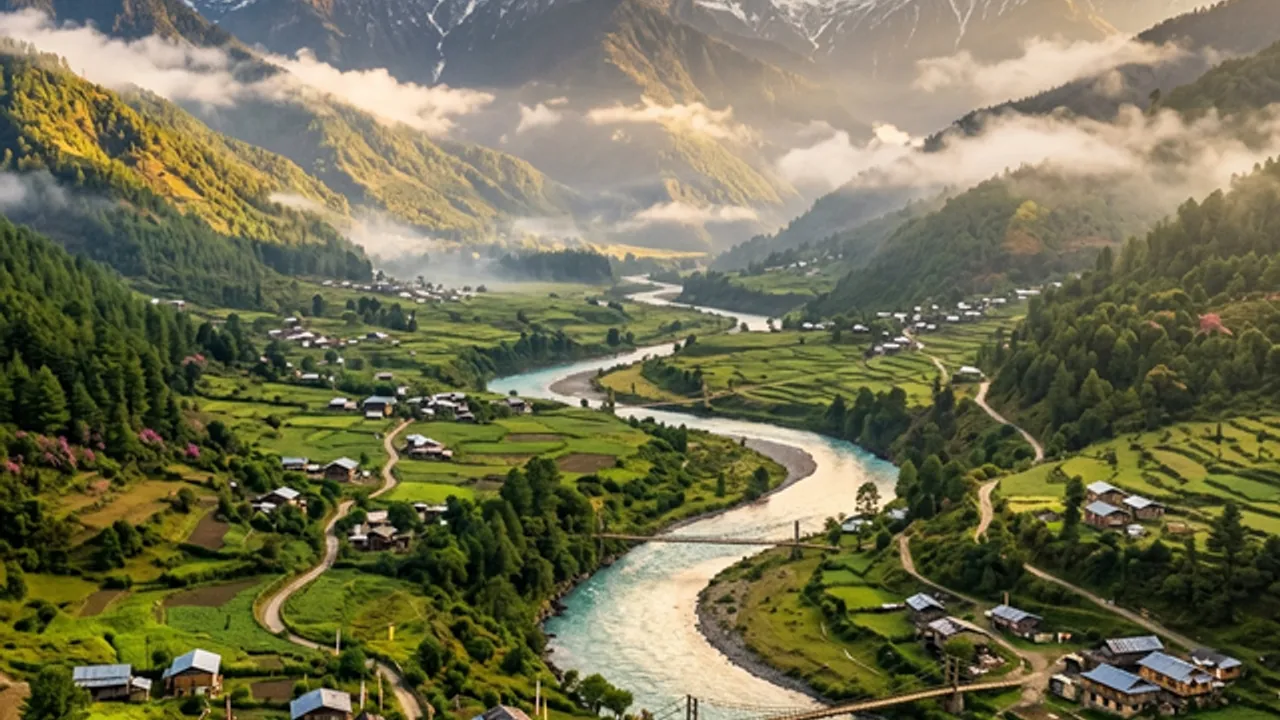
The Siyom River flows through the heart of Mechuka Valley and is the geographical and cultural axis around which everything else in the valley organises itself. The farmland follows its banks. The walking trails follow its banks. The hanging suspension bridge that spans it is a landmark that appears in every photograph of the valley — simple, functional, and connecting the monastery side to the village side in a way that is metaphorically perfect for a place built on the intersection of nature and culture.
The two-hour river walk along the Siang and Siyom banks takes you through the full range of what Mechuka's valley floor looks like at ground level: cultivated terraces, bamboo groves, stretches of riverine forest where the birdlife is extraordinary (the Siyom Valley is a designated Important Bird Area with documented sightings of multiple Himalayan and Northeast Indian endemics). The water colour shifts between jade and turquoise depending on time of day, cloud cover, and what the upstream glaciers are doing. At golden hour, the river looks like a painting someone decided was too obvious.
Golden Hour Photography
The river walk at 5 PM in autumn gives the definitive Mechuka valley photograph — warm light, clear water, snow peaks.
Birdwatching
The riverine forest along the Siyom is a documented Important Bird Area. Bring binoculars for Himalayan endemic species sightings.
Hanging Bridge
The suspension bridge views upstream and downstream are spectacular. Walk to the midpoint and stop. Look in both directions.
Dorjeeling Village — Authentic Memba Life
A traditional Memba community two hours' walk from Mechuka town, where the architecture is wood and stone and the pace of life is set by the agricultural season
The Memba people are the indigenous inhabitants of the Mechuka Valley — a Tibeto-Burman community who have maintained their language, Buddhist spiritual traditions, traditional wooden architecture, and farming practices in the upper Siang Valley for centuries. Dorjeeling village, approximately two hours' walk from Mechuka town, is one of the most accessible traditional settlements and offers what may be the most authentically immersive cultural experience available in India's northeast in 2026.
Walking through the village — past the interlocking wood-and-stone houses that have been built in the same style for generations, the stacked firewood, drying crops, and the carved wooden doorframes — feels profoundly different from anything a conventional tourism circuit provides. The architecture itself is a form of cultural expression: every joint, every carved beam, every arrangement of stone is the product of a building tradition that evolved in specific response to this specific climate, this specific forest, this specific way of life. Village elders, approached properly through a local guide who can make the introductions and provide linguistic context, will often share stories that no guidebook contains.
Cultural Protocol: Always visit Memba villages with a local guide who can make proper introductions. Arriving unannounced is culturally inappropriate. Always ask explicit permission before photographing individuals. Small courtesy gifts from Aalo — dried fruit, sweets — are a well-received gesture. Leave absolutely no waste of any kind in the village. These protocols are not suggestions; they determine whether the community continues to welcome visitors at all.
Winter Mechuka — A Valley Transformed
Snow covers the valley from December to February, and the Mechuka that emerges from under it is a completely different place — emptier, quieter, and in its own way more extraordinary
Those who visit Mechuka in winter between December and February encounter a valley that most travelers never see. The snow transforms the landscape into something ethereal — the wooden village structures contrast against white ground, prayer flags pop with colour against grey-white winter skies, and the monastery seems to float above a frozen world where all the usual sounds of the valley have been absorbed by snow.
Winter Mechuka is genuinely for experienced travelers comfortable with cold and capable of managing limited facilities. The number of visitors drops to near zero. Some roads can become icy and difficult. Certain facilities shut down or operate minimally. But the reward is a level of solitude and visual drama that is simply unavailable in any other season — and the experience of visiting a Himalayan valley monastery in winter, when the monks maintain their routines with no audience, is something that stays with people for the rest of their lives. Access this window with a verified local guide who can manage road conditions and accommodation realistically.
Also Visit: Gurudwara Mechuka Sahib — This Sikh shrine in the heart of Mechuka carries a fascinating cross-cultural history. Built in memory of a Sikh trader who reportedly arrived in Mechuka centuries ago and settled among the Memba community, the Gurudwara is maintained by the local community across faiths — a remarkable example of Mechuka's culture of inclusive coexistence. Pilgrims and general visitors are both welcomed warmly. Ask your host for the exact location and best visiting time.
Activities in Mechuka: The Full Range
Mechuka's activities span gentle cultural walks to serious multi-day wilderness treks. Most require a local guide for safety, access, and the cultural context that makes the difference between a walk through a landscape and an experience of it.
Valley and Forest Trekking
Half-day walks to multi-day expeditions toward remote passes. Routes through rhododendron forests, river valleys, and high meadows.
Landscape Photography
Every hour of light offers different material. Dawn monastery, golden hour river, Milky Way nights. A photographer's destination of rare quality.
Monastery Dawn Visit
The single most memorable experience in Mechuka for most travelers. Attend morning prayers with local host guidance.
River Walks and Bridge Crossings
The Siyom and Siang river trails take 2 hours and show the valley at its full scale. Peaceful, scenic, and accessible to all.
Dark Sky Stargazing
Away from any light pollution, the Milky Way is visible with the naked eye from the valley floor. Bring a blanket and allow 30 minutes for your eyes to adjust.
Cultural Immersion via Local Hosts
Cooking demonstrations, weaving observations, and community meals arranged through TravelBuddiz verified Memba hosts.
Himalayan Camping
Overnight camping away from the town with a local guide. The mountain silence and dawn views are worth every preparation effort.
Village-to-Village Treks
Multi-day routes connecting remote Mechuka villages. Among the most immersive experiences available in Northeast India — specialist guide required.
Mechuka Adventure Festival
Annual event celebrating adventure sports, Memba dance, and indigenous music. Check exact dates with Arunachal Tourism before planning.
Mechuka Budget Breakdown: Real 2026 Numbers
Mechuka is not an expensive destination by India standards — the valley's limited commercial infrastructure keeps prices low. The cost driver is transport: the long road journey and the 4x4 requirement on the Aalo–Mechuka stretch. Sharing this cost across a group of 4 transforms the trip's economics. All figures below are per person in a group of 4.
| Category | Budget Option (per person) | Mid-Range (per person) | Notes |
|---|---|---|---|
| Guwahati to Tezpur | ₹300–500 (shared bus) | ₹600–900 (shared cab) | Book shared cabs from Guwahati's taxi stands |
| Tezpur to Aalo (overnight) | ₹400–700 (shared Sumo) | ₹1,200–1,800 (private) | Shared Sumos run early morning; book night before |
| Aalo accommodation (1 night) | ₹500–800 | ₹1,200–2,000 | Multiple guesthouses near the main market |
| Aalo to Mechuka 4x4 (÷4) | ₹1,500–2,000 | ₹2,500–3,500 | Shared across group — biggest cost saving lever |
| Mechuka accommodation (per night) | ₹600–900 (homestay) | ₹1,200–1,800 (guesthouse) | Book in advance; limited capacity at peak season |
| Food (per day in Mechuka) | ₹300–450 | ₹600–900 | Homestay meals often included — confirm when booking |
| Local guide (per day) | ₹600–800 (group split) | ₹1,200–1,500 (private) | Essential for monastery visits and village access |
| ILP fee (Indian nationals) | ₹100–200 | ₹100–200 | Same fee regardless of stay duration |
| Total 5-Day Trip (group of 4) | ₹9,500–14,000 per person | ₹16,000–26,000 per person | Including all transport both ways |
Group Cost Saving: The Aalo–Mechuka 4x4 is the single largest variable cost. A vehicle costs ₹6,000–8,000 for the full trip — split across 4 people it's ₹1,500–2,000/head vs ₹6,000–8,000 for a solo traveler. Find co-travelers via TravelBuddiz before departure to halve your transport cost. For the complete framework, see our Budget Group Travel India guide →
Essential Travel Tips for Mechuka 2026
Cash Only Beyond Aalo
ATMs are extremely limited or absent in Mechuka. Withdraw all cash you need in Aalo. ₹5,000 minimum per person for a 5-day trip in the valley.
BSNL Only
Only BSNL SIM cards have coverage across most of Mechuka Valley. Airtel, Jio, and Vi are largely non-functional. Buy or activate a BSNL SIM in Guwahati before departure.
Download Everything Offline
Maps.me offline map for the Mechuka area, your host's number, guide's number, and any booking confirmations — all saved offline before you leave Aalo.
Warm Layers Always
Valley days can be warm in spring and autumn but evenings drop significantly. Mornings above the valley floor require a down jacket at minimum in any season.
Medical Self-Sufficiency
Pharmacy access is extremely limited in Mechuka. Carry personal medications, a basic first aid kit, antacids, and ORS sachets. The nearest hospital is in Aalo.
Book Accommodation Early
Mechuka has limited accommodation. For October–November and March–May windows, book at least 3–4 weeks ahead. Homestays with meals included are both better value and more authentic than standard guesthouses.
◆ Why Local Hosts Make the Difference in Mechuka
- Most generic travel agencies offer Mechuka packages without local contacts — they book the accommodation remotely and provide no on-ground support when road conditions change or accommodation is unavailable. Local hosts know the road before you drive it.
- The Samten Yongcha dawn prayers, the right village connections, the hidden river trails, and real-time permit handling — these require knowledge that no outside agency has. They require a person who was born here.
- TravelBuddiz verified Mechuka hosts are manually KYC-verified locals with documented knowledge of the valley — not anonymous listings. Every host is real, identifiable, and accountable.
- Community-based travel directly benefits the Memba families who host you — not the agency middlemen in Guwahati or Delhi who have never seen the monastery. This is the responsible way to travel in sensitive border communities.
Mechuka at a Glance
| Detail | Information |
|---|---|
| State | Arunachal Pradesh, India |
| District | West Siang |
| Altitude | Approximately 6,000 feet (1,828m) |
| Nearest Airport | Dibrugarh, Assam (IATA: DIB) · Guwahati (IATA: GAU) |
| Nearest Town | Aalo / Along (165 km, 5–6 hours) |
| Best Seasons | March–May (Spring) · October–November (Autumn) |
| ILP Required | Yes — all visitors. Apply at arunachalilp.com |
| Mobile Network | BSNL only (most of the valley) |
| Cash | Essential — withdraw in Aalo; no ATMs in valley |
| Languages | Memba, Hindi, Basic English |
| Annual Visitors | Fewer than 15,000 |
Mechuka Pre-Departure
Checklist — Complete These
Everything You Need to Know
Go Before the World Catches Up.
Mechuka is at the precise moment before commercialization reaches it — accessible enough to get to, still raw enough to feel genuinely remote. The travelers who visit in 2026 see it at its best. The destinations that reward genuine effort are disappearing faster than anyone is counting. This is one of the ones that still requires effort, and still gives back everything you put in.
Find Your Mechuka Travel Companion →