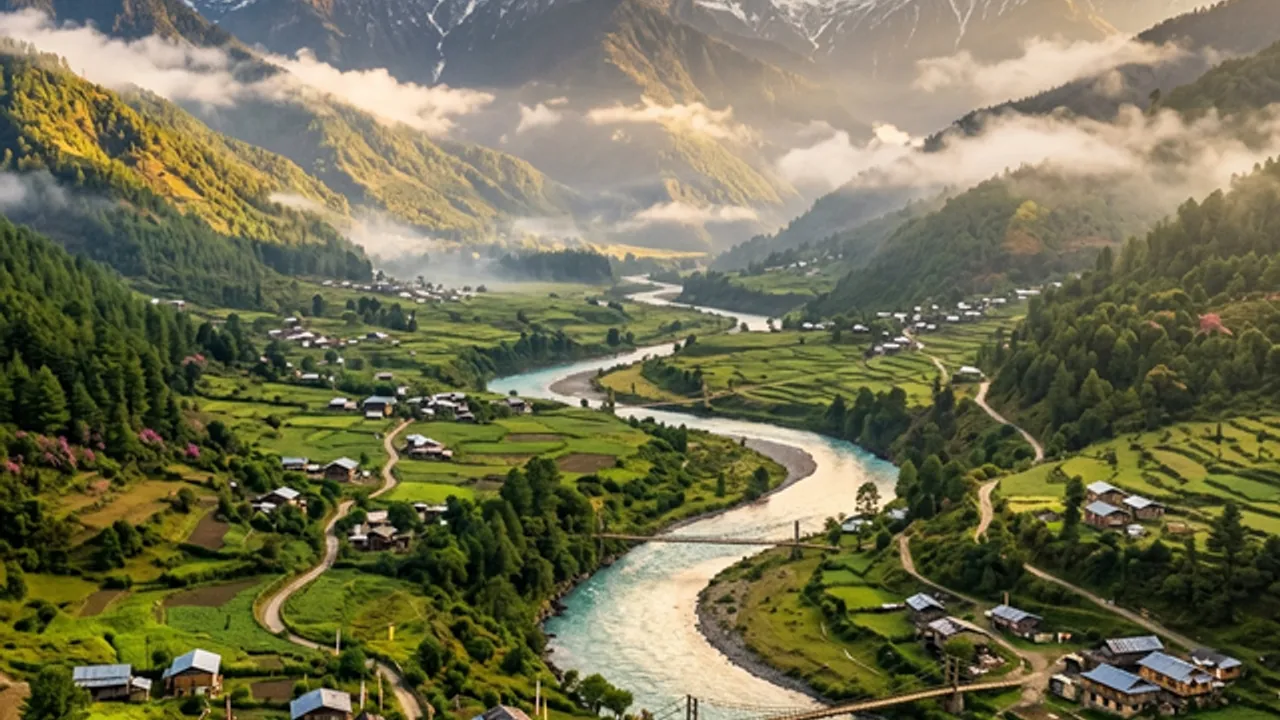
The roar of the Brahmaputra isn't just a sound. Crossing the Bogibeel Bridge at first light, you feel it in the soles of your feet — a low, constant vibration that the river has been generating for longer than any city on this continent has existed. Northeast India announces itself physically before it announces itself visually, and that sequence is deliberate. This is a region that wants to be felt before it is understood. Comprising eight states — the Seven Sisters and One Brother — it contains more linguistic variety per square kilometre than any other part of India, more biodiversity than most countries, and fewer tourists than almost anywhere else that deserves them. Less than 1% of India's total tourist traffic reaches this frontier. The reward for being among that 1% is what the rest of the country is rapidly running out of: genuine wilderness, communities that haven't yet learned to perform for cameras, and the specific peace of places that don't know they're supposed to be famous yet.
"You can hike for four hours in Arunachal and not see another traveller. In Meghalaya, a Khasi grandmother will invite you in for rice beer before you've even asked for directions. This is what India looked like before infrastructure caught up with curiosity."
— Kabir Deka, Verified Local Host · Guwahati, Assam
Northeast India: Quick Reference
| State | Top Experience | Permit (Indian) | Best Months |
|---|---|---|---|
| Arunachal Pradesh | Tawang Monastery, Mechuka Valley | ILP Required | Mar–Jun, Sep–Nov |
| Meghalaya | Living Root Bridges, Mawlynnong | No Permit | Oct–May |
| Assam | Kaziranga Rhino Safari, Tea Gardens | No Permit | Nov–Apr |
| Nagaland | Hornbill Festival, Dzukou Valley | ILP Required | Oct–Dec |
| Sikkim | Gurudongmar Lake, Goechala Trek | No Permit | Mar–Jun, Sep–Nov |
| Manipur | Loktak Lake, Sangai Festival | No Permit | Oct–Mar |
| Mizoram | Phawngpui Peak, Reiek Heritage Village | ILP Required | Oct–Mar |
| Tripura | Unakoti Rock Carvings, Ujjayanta Palace | No Permit | Oct–Mar |
Why Northeast India in 2026 — The Accessibility Shift
The Northeast has always been extraordinary. What's changed in 2026 is that it's no longer extraordinary and logistically punishing at the same time. The Sela Tunnel in Arunachal Pradesh — at 13,000 feet, Asia's longest bi-lane tunnel — opened in 2024, reducing the Tawang approach to an all-weather route that no longer depends on the mountain weather gods for access. New direct flights from Bengaluru and Hyderabad to Dibrugarh and Imphal have been added. Mobile connectivity via Jio has reached district headquarters that two years ago had no signal at all.
But the soul of the region remains entirely intact. The Dzukou Valley still requires an 8-hour trek. The living root bridges of Nongriat still take an hour of stair-climbing to reach. The monasteries at Tawang still wake at 5 AM to the same chants they have been waking to for three centuries. Accessibility has improved; the reward for making the journey has not diminished.
Sela Tunnel Open
All-weather access to Tawang — no more being stranded by the pass. Asia's longest bi-lane tunnel at 13,000 ft.
New Flight Routes
Direct flights from Bengaluru, Hyderabad, and Chennai now reach Dibrugarh and Imphal — cutting journey times significantly.
Improved Connectivity
Jio and Airtel coverage extended to district headquarters across Arunachal and Nagaland. BSNL still best for remote areas.
Homestay Boom
Community-run homestays in Mechuka, Dzukou, and Mawlynnong have expanded significantly — authentic, affordable, and trust-reviewed.
Online ILP in 24–48 Hours
Arunachal's e-ILP portal now processes applications within 24–48 hours. Nagaland's portal processes in 48–72 hours.
<1% Tourist Share
Despite all improvements, the Northeast still receives less than 1% of India's total tourist traffic. The crowds haven't arrived yet.
The Eight States — Distinct Worlds Within a Region
The phrase "Seven Sisters and One Brother" refers to the political and geographic relationship between the eight northeastern states — the original seven sisters (Assam, Arunachal Pradesh, Meghalaya, Nagaland, Manipur, Mizoram, Tripura) and Sikkim, which joined the Indian Union separately in 1975 and is considered the "Brother." Each state has a distinct tribal culture, topography, climate, and character. Treating the Northeast as a single destination is like treating Europe as a single country — technically accurate at the largest scale, deeply misleading in practice.
Assam — The Gateway State
Kaziranga's one-horned rhinos, Brahmaputra river cruises, tea gardens, and the ancient Kamakhya Temple. Guwahati is the region's primary entry point.
No Permit Wildlife Tea Culture
Meghalaya — Kingdom of Clouds
The wettest place on Earth, living root bridges grown over generations, Dawki's crystal-clear river, and the cleanest village in Asia at Mawlynnong.
No Permit Caves Root Bridges
Arunachal Pradesh — The Rising Sun
India's largest state by area. Home to the Tawang Monastery, Mechuka Valley, Ziro Valley music festival, and Sela Pass at 13,700 feet.
ILP Required Monasteries High Altitude
Nagaland — Warrior Culture
Sixteen Naga tribes, the Hornbill Festival (Dec 1–10), Dzukou Valley trek, and Mon district's Konyak headhunter villages that still remember the old traditions.
ILP Required Tribal Culture Trekking
Sikkim — Buddhist Himalaya
Gurudongmar Lake at 17,800 feet, the Goechala trek to Kangchenjunga base, Rumtek Monastery, and India's first fully organic state.
No Permit Trekking Buddhist Culture
Manipur, Mizoram & Tripura
Loktak Lake's floating phumdis, Mizoram's rolling bamboo hills, Tripura's ancient Unakoti rock carvings dating to the 7th century CE.
Mixed Permits Offbeat Rock ArtTawang — India's Himalayan Crown
At 10,000 feet, surrounded by ridges that hold snow nine months of the year, Tawang Monastery is India's largest Buddhist monastery and the second-largest in Asia after Lhasa's Potala. It was founded in 1681 by Merak Lama Lodre Gyatso, a disciple of the Fifth Dalai Lama. The monastery complex houses 450 monks, a 28-foot gold-plated statue of the Buddha, and an 18th-century library of manuscripts that survived the 1962 India-China war stored in hidden chambers.
The morning prayer session begins at 5:30 AM. The monks file into the main hall in wine-dark robes, the trumpets sound from the roof, and the butter lamps illuminate gilded faces that have been watching over this valley for three and a half centuries. This is the moment Tawang is built around. Everything else — the Sela Pass drive, the Madhuri Lake at 12,000 feet, the Bumla border post — is context for this specific half hour before sunrise.
Tawang Monastery — Dawn Visit
Founded 1681. Houses 450 monks. Morning prayers begin 5:30 AM — arrive by 5:00 AM for the procession. Entry free; photography permitted in outer courtyards, restricted inside the main hall. The monastery museum (entry ₹50) contains original 17th-century thangkas.
10,000 ft Elevation ILP Required 420 km from GuwahatiMeghalaya — The Kingdom of Clouds
Meghalaya's jingkieng jri — living root bridges — are not built. They are trained. Over 15 to 20 years, Khasi communities guide the aerial roots of the rubber fig tree (Ficus elastica) across streams and rivers, weaving them through bamboo frames until the root structure becomes self-supporting. The bridges take a generation to mature and last for centuries after the frame is removed. The double-decker bridge at Nongriat, 3,500 steps below the nearest road, is the most famous. But the single bridges at Nongthymmai and Kudeng Rim are quieter and equally extraordinary.
"The Khasi built bridges without engineering degrees and they're still standing after 500 years. We built the concrete ones in the 1990s and most of them are already gone."
— Bah Kyrshan Dohling, Community Guide · Nongriat, MeghalayaUnderground, Meghalaya has a separate claim on the superlative. The Jaintia Hills contain over 1,000 documented cave systems. Krem Puri is the world's longest sandstone cave at 24.58 km. Siju Cave has a section called the Bat Cave — three kilometres of limestone formations and a colony of roughly three million bats. Krem Chympe has no floor lighting, no handrails, and requires wading through waist-deep underground rivers. This is what adventure travel looks like when it hasn't been safety-buffered into a theme park.
Nagaland — The Hornbill Festival & Dzukou Valley
The Hornbill Festival runs every year from December 1 to 10 at Kisama Heritage Village, 12 km from Kohima. All 16 major Naga tribes — Angami, Ao, Chakhesang, Chang, Konyak, Lotha, Phom, Pochury, Rengma, Sangtam, Sumi, Yimchunger, Zeliang, and others — set up camps and perform together on a scale that nothing else in India quite matches. The Konyak tribesmen of Mon district, whose elders still have the traditional face tattoos of the former headhunting tradition, are the most photographed. But the Angami and Ao traditional dances, the log-drum music, and the morungs (traditional warrior dormitories, now rebuilt as cultural exhibits) are equally worth days of attention.
The Dzukou Valley sits at 2,438 metres on the Nagaland-Manipur border and is accessible via an 8-hour trek from Viswema village. The valley floor is carpeted with Dzukou lilies — an endemic species that blooms only here, in July and August. The trek is classified as moderate but the overnight camp at the valley (₹300 per night in Forest Department shelters) sits in a silence so complete that the loudest sound is your own breathing.
Sikkim — Gurudongmar Lake & Kangchenjunga's Shadow
Gurudongmar Lake sits at 17,800 feet — one of the highest lakes in the world and among the most sacred in Buddhist and Hindu traditions. The water remains partially unfrozen even in winter, which locals attribute to the blessing of Guru Padmasambhava, who is said to have blessed the lake during his 8th-century journey through the Himalayas. The drive from Lachen covers 62 km of increasingly austere terrain — the last 20 km are above the treeline, the landscape lunar and windswept and indifferent to your presence in the most clarifying possible way.
The Goechala trek (7–10 days, 90 km) is widely regarded as the finest Himalayan trek in India that doesn't require technical mountaineering skills. On Day 6, the Goechala viewpoint at 4,940 metres offers a direct sightline to Kangchenjunga (8,586 m), the world's third-highest peak. On clear mornings, the full south face is visible from base to summit. No other accessible viewpoint in India offers this unobstructed a view of a mountain of this size.
Best Time to Visit — Month-by-Month
| Region | Best Months | Why |
|---|---|---|
| Arunachal (Tawang, Mechuka) | Mar–Jun, Sep–Nov | Mountain roads clear, skies open, comfortable temperatures (8–18°C) |
| Assam (Kaziranga) | Nov–Apr | Wildlife safaris active, dry weather, optimal rhino visibility |
| Meghalaya | Oct–May | Post-monsoon freshness, waterfalls at peak flow, cave trekking season |
| Nagaland | Oct–Dec | Hornbill Festival (Dec 1–10), harvest season, clear weather |
| Sikkim | Mar–Jun, Sep–Nov | Mountain visibility, trekking season, rhododendron bloom (Mar–Apr) |
| Manipur / Mizoram / Tripura | Oct–Mar | Dry season, manageable temperatures, cultural festival period |
| Best Overall Window | October–November | Best overlap across all states; Hornbill prep, pre-winter clarity |
Permits & Documentation — Complete Guide
The permit system is the single biggest practical consideration for Northeast India travel. It is not difficult to navigate once you understand the structure — but the consequences of showing up at a checkpoint without valid documents range from being turned back to a significant fine, depending on the state and the specific area.
🗂️ Permit Requirements by Category
Indian Citizens — ILP States
- Arunachal Pradesh: ILP mandatory
- Nagaland: ILP mandatory
- Mizoram: ILP mandatory
- Apply: State e-ILP portals online
- Processing: 24–72 hours typically
- Carry multiple printed copies
Indian Citizens — No Permit
- Assam: No permit required
- Meghalaya: No permit required
- Tripura: No permit required
- Sikkim: Free ILP at entry checkpoints
- Manipur: No permit required
- Standard ID documents sufficient
Foreign Nationals
- PAP required: Arunachal, Nagaland, Mizoram, parts of Manipur
- RAP required: Nathula, Gurudongmar (Sikkim)
- Apply via registered tour operators only
- Processing: 2–4 weeks minimum
- Some border areas remain restricted regardless
Key Permit Portals
- arunachaliilp.in — Arunachal ILP
- Nagaland ILP: nagalandilp.in
- Mizoram ILP: migrationmizoram.nic.in
- Sikkim: sikkimtourism.gov.in
- Fee range: ₹100–₹500 per permit
Getting There & Getting Around
Reaching the Northeast
By Air — Guwahati is the Hub
Lokpriya Gopinath Bordoloi International Airport (GAU) has direct flights from Delhi, Mumbai, Kolkata, and Bengaluru. Secondary airports: Imphal (Manipur), Dibrugarh (Assam), Agartala (Tripura), Bagdogra (Sikkim gateway), Lengpui (Mizoram). Check schedules at AAI Airport Authority.
By Train — Northeast Frontier Railway
Guwahati Junction is the primary rail hub, well-connected via the Northeast Frontier Railway to Dibrugarh, Tinsukia, Silchar, and Agartala. Book via IRCTC at least 30 days in advance for peak months. The overnight Rajdhani from Delhi to Guwahati takes roughly 19 hours.
Getting Around — The SUV Economy
Mountain roads beyond major towns require SUVs or 4x4 vehicles. Private hire costs ₹4,000–₹6,000 per day. Shared Sumos/Boleros run fixed routes for ₹200–₹500 per seat. Splitting a private SUV across 3–4 travellers on TravelBuddiz brings the per-person cost to ₹1,000–₹1,500 per day — the most cost-effective approach for mountain routes.
Connectivity & Cash
BSNL has the widest coverage in remote Northeast. Jio and Airtel cover district headquarters and major towns. Download offline maps on OsmAnd or Maps.me before entering remote areas. ATMs are scarce beyond major towns — carry sufficient cash. Most homestays are cash-only.
Sample 14-Day "Best of Northeast" Itinerary
For travellers with two weeks, this route covers three key states — Assam, Meghalaya, and Arunachal Pradesh — and hits the most significant experiences without rushing. It is designed around realistic road conditions and travel times, not optimistic map distances.
| Days | Destination | Key Activities |
|---|---|---|
| Day 1–2 | Guwahati, Assam | Kamakhya Temple, Brahmaputra sunset cruise, Umananda Island, local mustard fish curry dinner |
| Day 3–4 | Kaziranga, Assam | Elephant-back safari at dawn (one-horned rhinos), jeep safari (tigers, water buffalo), tea garden walk at sunset |
| Day 5–7 | Shillong & Cherrapunji, Meghalaya | Living root bridges at Nongriat, Mawlynnong (Asia's cleanest village), Dawki river, Nohkalikai Falls, cave trek |
| Day 8–9 | Dirang, Arunachal Pradesh | Sangti Valley birding, Dirang Dzong, natural hot springs, local Monpa homestay |
| Day 10 | Sela Pass | Sela Lake at 13,700 ft, War Memorial, descend into Tawang Valley |
| Day 11–13 | Tawang, Arunachal Pradesh | Tawang Monastery dawn prayer, Madhuri Lake (12,000 ft), Bumla Pass border viewpoint, Shungetser Lake, Tawang War Memorial |
| Day 14 | Return to Guwahati | Fly Tawang–Guwahati (IndiGo operates this route), departure. Or extend to Nagaland if time permits. |
14-Day Northeast Trip — Practical Logistics
Cultural Etiquette — Respect as the Entry Ticket
The Northeast is culturally distinct from mainland India in ways that matter to the communities who live there. The protocols below aren't restrictions — they're the minimum required to be considered a respectful guest rather than another extractive tourist.
Ask Before Photographing
Always ask before photographing tribal elders, religious ceremonies, or people inside homes. A refused request should be accepted without argument.
Zero Plastic Commitment
Sikkim and Meghalaya have strict anti-plastic rules. Carry a reusable water bottle and cloth bags. Plastic waste left in villages is not just illegal — it's deeply offensive to communities that actively keep their environment clean.
Align With the Sun Schedule
Life starts at 4–5 AM and most towns shut by 7–8 PM. Plan your travel and meals accordingly. Don't expect restaurants to be open at 9 PM.
Eat What's Offered
Fermented bamboo shoots, smoked pork, rice beer (chi), and apong are staples across the region. Refusing food in a Naga or Khasi home is more offensive than any dietary preference is worth. Eat something, thank the host sincerely.
Language Awareness
English is widely spoken in Meghalaya, Nagaland, and Mizoram. Hindi is functional in Arunachal and Assam but less reliable. Never assume Hindi fluency — it's linguistically tone-deaf in states where the colonial and post-independence relationship with Hindi is complicated.
The Stranger Protocol
If someone invites you into their home, they mean it. Northeast hospitality is not a transaction. You are expected to sit, eat, and stay for a conversation — not take a photo and move on. The communities that offer genuine hospitality deserve genuine presence in return.
Northeast India Packing Essentials
Frequently Asked Questions
Further Reading & Resources
The Northeast Doesn't Ask You to Visit. It Asks You to Show Up.
This is a region that rewards preparation, patience, and genuine curiosity. The logistics are real but manageable. The communities are extraordinary and deserve to be encountered as they are — not as you'd like them to be. Go with a local host who knows the trails, the festivals, and the families. Then go slow.
Explore Northeast Trips → Find a Local Host